Our kids have grown up believing, at various points, that their parents helped build the pyramids, flew reconnaissance missions against the Red Baron, and once fed the Loch Ness Monster from a rowboat off the coast of Scotland. None of it happened, but these wild stories dated back before we were even born made for some exciting bedtime stories. We are a family of readers.
But we have always loved the Secondhand Lions and Big Fish movies where the story is never quite verifiable, and for the sake of a wildly good story, that's the whole point. The uncle who may or may not have robbed banks, the father whose entire life resembles a tall tale, right up until the truth is becomes clear or verified. We loved the not-knowing and watching someone build a legend out of nothing. So when our own kids were small, we did the same thing to them, on purpose, at bedtime, for years. Even now, as teenagers, we leave them perplexed with wartime stories about how we snuck onto pirated sailboats, dined in Cuba, and overtook a billionaire's bunker. (Seems relevant these days.)
By day, we're software engineers. At night, we write cozy mysteries and adventures under pen names (for the sake of our current jobs), which is a strange kind of double life. For us, this is the norm, but we know it might seem unusual.
The Software We Used Had Process Problems
The writing is not actually the hard part. As a writing and storytelling team at home, we're never without an idea for a wild story. The hard part is the part between the writing and publishing the book.
You notes are in one place, draft in one piece of software, format in another, social media assets in a whole other platform. Even though some of the drafting software offered a compiler and export options, it didn't always format or style the best for today's standards. Some of the best software that has been the longtime standard is arguably antiquated now. Somewhere in the middle of getting the book to publishing status, you export, you re-import, and you fix it by hand, again, on deadline, for the fourth book in a row in a formatting software that costs an insane amount of coin for many indie authors. We tried the usual combinations. Something for drafting, something else for typesetting, a folder system to keep it all straight. But the whole time, we had a nagging sense that we were duct-taping together a workflow that should have been one thing from the start. We needed something that wasn't going to create blockages.
We wanted our files with us wherever we sat down to write, synced without thinking about it, ready to download the moment we needed a clean copy. We wanted to be able to be on our phones getting down notes using the same app without losing anything. We wanted to stop treating "finishing a manuscript" and "producing a real, retailer-ready book" as two separate jobs done in two separate apps. Nothing on the market did both extremely well. So we built software over the spring and summer of 2026 creating a solution we desperately needed.
We Built Calamus
Calamus is Latin for "reed"—specifically, the reed pen, cut and split at the tip, that people used to write with for a couple thousand years before anyone thought to dip a feather quill in ink. It's one of the oldest tools humans have for turning a thought into something permanent. No formatting menu, no export settings—back then, it was all you needed. These days, we need substantially more modernized tools with the rise of independent authors and self-published writers. But the solution needs to be powerful, yet simple to understand. And it shouldn't take classes and a complicated manual to explain.
Our belief is that software should be joyful, vibe-friendly, and capture the spirit of the writer in their element. We wanted software that worked WITH a writer's creativity to allow them to be bold and make their mark. Lackluster, technically-complicated, and modern feature-void software has left writers wanting more; needing more.
And that's the spirit we wanted back, like the concept of the reed. One tool, one hand, one continuous act between having an idea and having a completed book you're actively marketing. We named the app after the calamus reed because that's the promise we're trying to keep: get out of your way, and let the writing be the writing, and get it in the hands of readers everywhere with less hassle: from start to finish.
The Full Suite
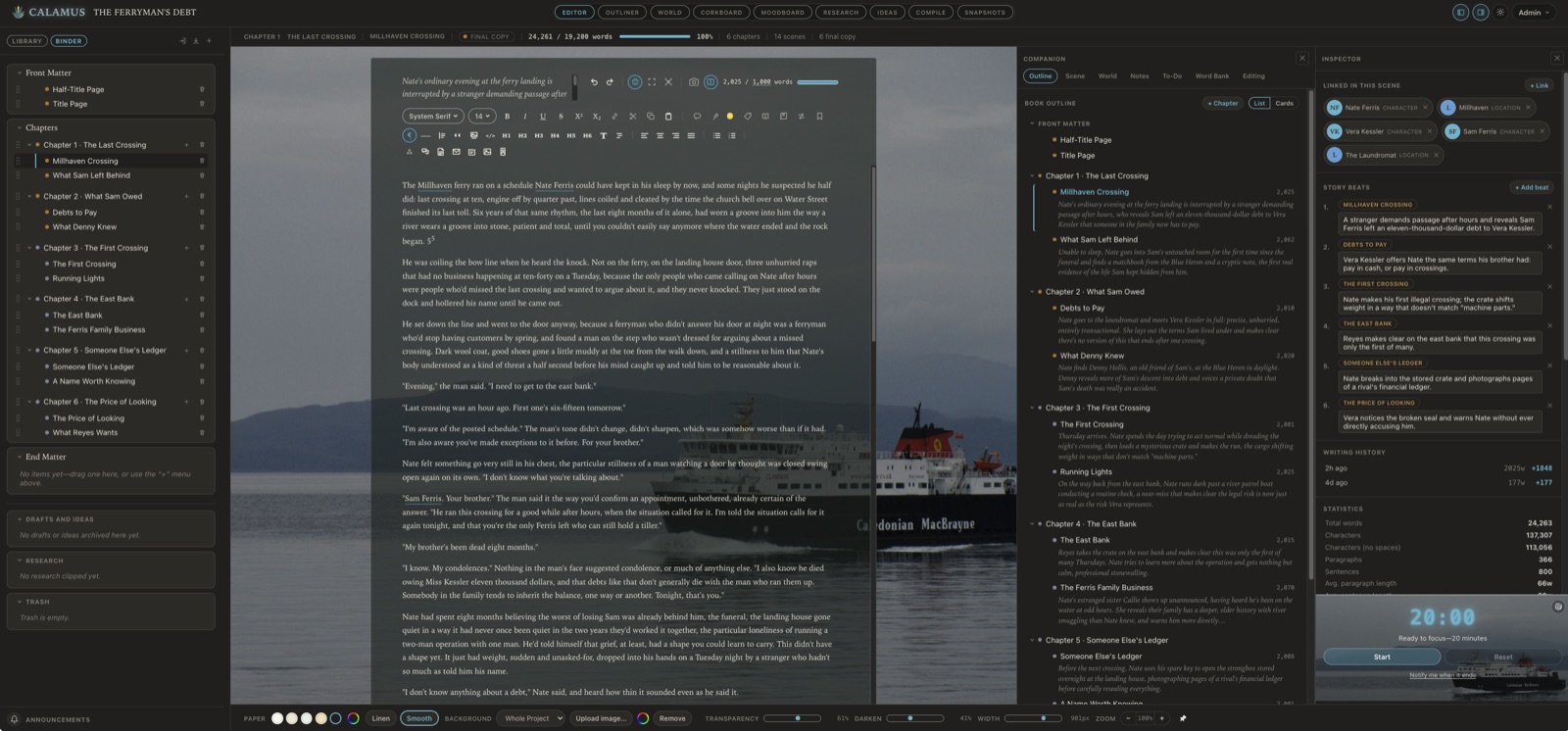
Calamus is a full writing suite: one place to get your ideas and brainstorming done, draft, organize, and create a real, finished book and market it, instead of stitching together five disconnected tools and forcing manual fixes when merging them together.
We created apps for iPhone, iPad, Mac, and browsers to address the natural flowstate of the writing process. You get Calamus Ideas for iPhone to get your ideas and notes down, that sync to your user account. A pen name dashboard to support all your multiple personalities as a writer. A binder to keep chapters and scenes in order, Focus & Composition Modes when the internet needs to not exist for a while, and Snapshots so a bad afternoon of edits is never a permanent decision, and to demonstrate your writing was human-generated. There's live tagging (codex features) for world building—characters, places, factions, timelines, even invented languages and magic systems—so you never accidentally rename a character in book three and have to hunt down every mention in books one and two. Highlight a name in your prose and it links straight to its Codex entry.
And when the draft is actually a book and has been through all the drafting processes, Compile turns it into a real one: EPUB for Kobo, Apple Books, and Google Play, or a print-ready PDF in whatever trim size your retailer actually accepts, with new designs constantly being made. So if you haven't seen new designs from your current formatting software, know that we have you covered. Over 1,900 Google Fonts, properly embedded. Same manuscript, every distributor, formatted correctly for each.
It's the app we built for two people writing after the kids went to bed, wedged between day jobs and pen names, who wanted to stop losing an evening to file formats. It took us working long nights to get it done, and it's officially in beta status.
Where We Go From Here
We're not finished with Calamus, and we don't expect to be. We built it because we wanted it badly and believe in it, which means we'll keep improving it for the same reason—because we're using it too, on our own manuscripts, under our own pen names. If something's missing or something's in your way, we want to hear about it. We know what that's like.
We wanted to bring the joy back to writing and leave the frustrating parts like yesterday's chapter: where the tools disappear and the only thing left is the page, the story, and whatever wild, unprovable thing you're writing. Maybe it's a novel. Maybe it's a bedtime story about the Loch Ness Monster that your kids will tell their own kids one day, swearing it's true.
Either way, we can't wait to see you use it.
Calamus is currently in early beta access, and it's being tested and used by a curated selection of writers under NDA who are familiar with several types of writing software. These users are our test cases and have been helping us identify small improvements and suggestions to ensure it's the best it can possibly be. Our team of beta writers have been active on social media discussing writing software, and without their insight and input, Calamus would not be where it is today. A big thank you to them! If you're interested in using the next best software for writers, join the waitlist to be first in line when we open the doors.
Chad & Melody
Co-founders of Calamus
The Calamus Team