Ask a room of novelists how they work and you get two answers, given with equal certainty. Some plan the book before writing it. Some find the book by writing it. Both groups finish novels, and readers cannot tell from the page which method produced the book in their hands.
What differs is where the thinking happens. A plotter does the structural thinking before the prose. A pantser does it during, and often again afterward. That single difference changes what each one wants from software, and it explains why the same app can feel indispensable to one writer and beside the point to another.
What Plotting Looks Like
A plotter approaches the first page with a shape of the book already worked out. The depth of detail varies enormously. Some outline to the story beat, a paragraph per scene with the turn identified in each. Others write a page of structure and consider that sufficient.
The common thread is a decision made in advance about what happens and in what order, held somewhere the writer can consult it.
What this buys: a plotter rarely writes 30,000 words in a direction that gets cut. Subplots can be seeded early because the writer knows what they are seeding for. Series continuity is easier, because the timeline and the cast exist as a record from the start. Foreshadowing is a matter of planning rather than a matter of going back and inserting it. Melody is most definitely a plotter whereas Chad is more of a pantser, in case you're wondering. And on any given morning for her, the question of what to write is already answered, which is a real advantage on the days when momentum is thin.
What it costs: an outline is a set of predictions about a book that does not exist yet, and some of those predictions turn out to be wrong once the characters are on the page and behaving like themselves. A plotter who treats the outline as binding can end up writing the scene they planned instead of the scene the story now wants. The skill is knowing when to revise the plan.
What Pantsing Looks Like
A pantser (like Chad over here with his adventure fight scenes) starts with less: a situation, a voice, an image, a character in a specific moment, and finds out what the book is by writing it. The structure emerges and is usually clarified in revision.
What this buys: discovery. Scenes go places the writer did not plan, and those detours are often the best material in the book, because they came from the logic of the characters rather than from a plan made before the characters existed. Prose written this way frequently has more life in it. Dialogue in particular tends to be better, because the writer is finding out what people say at the same moment the characters are.
What it costs: rewriting. A discovery draft usually contains a first act aimed at a book that turned out to be a different book, and a middle that finds its subject somewhere around chapter 14. That material has to be cut or rebuilt. Pantsers also carry a heavier revision load on continuity, because the details of the world were invented as needed rather than decided in advance.
We'll have you know that Melody ends up doing a lot of the rewrite work to mix in Chad's writing with the rest of the novel that has been strategically plotted.
The Hybrid, Which is Most Writers
Very few working novelists sit purely at either pole of outliners vs. pantsers. The common pattern runs something like this: a rough shape for the whole book, real detail for the next three or four scenes, and nothing much beyond that. The writer drafts into the detailed part, and as it runs down, plans the next stretch using what the draft has taught them.
Another widespread pattern is plotting the beginning and the end, then discovering the middle. A third is pantsing the first draft entirely and then outlining it, retroactively, as the first act of revision.
All of these are hybrids, and the ratio typically shifts across a career, and across genres. Mystery and thriller writers tend to plot more, because the reveal has to be engineered. Literary and character-led fiction tends toward discovery. A writer who does both will work differently on each.
What a Plotter Wants from Writing Software
We'll cover four things here, roughly in order of how much they matter.
An outliner. A view of the whole book as rows, with each scene's summary, point-of-view character, status and word count visible at once. The value is in seeing the entire structure without opening a single scene, which is how you notice that four chapters in a row are set in the same room, or that the point of view has not left one character for 60 pages.
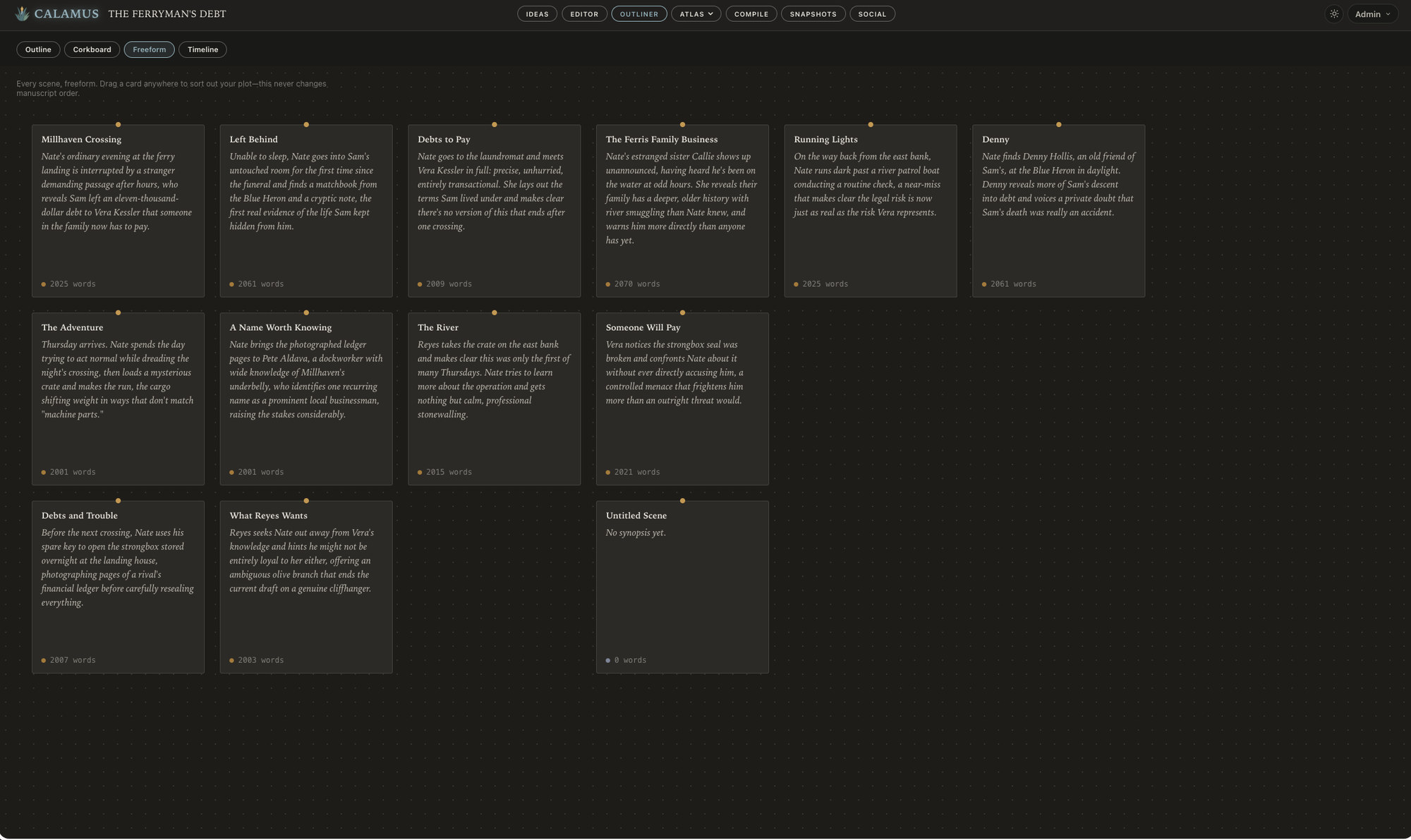
A corkboard. Scenes as cards you can pick up and move. Rearranging is a fundamentally spatial task, and doing it by dragging cards is different from doing it by cutting and pasting text, because you can see the whole sequence while you change it. Try an order, look at it, try another.
Story beats attached to scenes. The plan and the prose in the same place, so the beat you intended is visible while you write the scene rather than in a separate document you have to go and find. This is also how you check, at the end, whether the scene did the job it was assigned.
A structured world reference. Not a folder of notes, but typed records: a character with a field for age and role and relationships, a location with a field for region, a timeline with dates you can sort. Structure lets you ask questions of the material. Who was in the capital in the spring of the third year is answerable in a structured record and not in a document.
In Calamus these are the Outliner, the Corkboard, the story beats attached to each scene, and the Codex, which has 14 typed categories: Characters, Locations, Factions, Magic Systems, Lore, Cultures, Languages, Timeline, Glossary, Lineages, Regions, Maps, Storylines and Items. The feature overview covers how they connect.
Scrivener has been the serious novelist's manuscript organizer for close to 20 years, and it earned that position with exactly this set of tools; its Binder model has not aged and its Corkboard is still the reference implementation. If you already work that way and it suits you, it suits you. The comparison for writers considering a move is about what happens after the draft, not about the drafting.
What a Pantser Wants from Software
A different four.
A fast blank page. The distance between opening the app and typing the first word should be as close to zero as the software can make it. No dialog asking for a template, no structure to define before there is anything to put in it. A pantser with a sentence in mind needs somewhere to put it now, and a Binder that will accept an untitled scene and let it be named later gives them that.
Somewhere to capture what you discover, as you discover it. In a discovery draft, facts about the world are invented mid-sentence: the sister's name, the color of the uniform, the year the war ended. Those need to land somewhere that is not the middle of the manuscript, without breaking the sentence you were writing. A quick note, tagged, findable later.
Snapshots, so you can cut boldly. The freedom to delete 4,000 words and try the chapter another way depends entirely on being able to get those 4,000 words back. A version history changes the character of revision: you stop protecting text you are unsure about, because nothing is actually being destroyed.
A way to build the world record afterward. A pantser does not want to fill in a character sheet before the character exists. What they want, at the end of the draft, is to take the facts they invented along the way and put them somewhere structured, so that book two does not contradict book one.
In Calamus the corresponding pieces are Ideas, which captures notes on your phone and syncs them into the book; Snapshots, which keep earlier drafts you can restore; and the same Codex, filled in after the fact rather than before.
The Same Tool can Serve Both
The condition is that the structure is available rather than required.
An outliner that you have to populate before you can write is a plotting tool and nothing else. An outliner that fills itself in from the scenes you have written, and that you can also fill in ahead of time if you want to, works for both. The same is true of a corkboard: as a planning surface for a plotter, and as a way of seeing what you have got for a pantser halfway through revision. A codex you can populate on day one, or populate on day 90 from what the draft turned up, is useful to either writer.
That is the design question for a writing app, and it is what determines whether a writer uses one module or all of them.
For a hybrid, which is to say most writers, the practical answer is to pick tools that stay quiet on the days you are discovering and are ready on the days you are planning, and to expect your own ratio to shift from book to book. A full writing suite earns the setup by letting you leave most of it closed whenever you want to.
Chad & Melody
Co-founders of Calamus
The Calamus Team