A 30-day draft goal is a specific and useful exercise. You write a complete first draft of a novel in a month, at a pace that keeps you moving faster than your editing instinct can keep up with, and you finish with a manuscript that exists. This is what so many writers do during National Novel Writing Month in November.
It works because it removes the main variable of when to write. Instead of deciding each day whether to write, you have already decided, and the only question is when. Plenty of writers do it once and discover they can produce far more than they thought. Plenty do it every year because they enjoy the pace—and as a vast group of writers coming from all backgrounds and experiences, November is truly a uniquely exciting month for all of us.
Here is what it takes, in the order you need it, in case you're new to this phenomenon of writers everywhere joining together for a common cause.
The Math of the Draft
The traditional target is 50,000 words in 30 days. That is 1,667 words a day, every day, with no days off.
Some more useful versions of the same number:
- Writing 6 days a week, 26 writing days: 1,924 words a day.
- Writing 5 days a week, 22 writing days: 2,273 words a day.
- Weekly: 11,667 words, which is easier to plan around than a daily figure because it lets a bad Tuesday be repaid on Saturday.
At a typical drafting speed of 800 to 1,200 words an hour, 1,667 words is 90 minutes to two hours of actual writing. This is worth knowing before you start rather than discovering it on day 3—writing takes some serious invested time! (Which is why we typically write at night together when the kids are in bed.)
Two adjustments worth making, though, from our own experience. If your genre runs longer, a 90,000-word epic fantasy, 50,000 words is a partial draft and you should say so up front, so that finishing the month is a success rather than a shortfall. And if 1,667 does not fit your life this particular month, pick a number that does. A 30,000-word month completed is worth more than a 50,000-word month abandoned on day 9.
Prepare Just Enough to Get Writing
The preparation question splits people, and the answer for a fast draft is: enough that you never open the file with no idea what happens next, and no more than that.
Three documents, and they should take an afternoon between them.
A one-page premise. Who the protagonist is, what they want, what stands in the way, what changes by the end. Write it as prose, not bullets, and keep it to a page. If you cannot get it onto a page, the book is not ready to be drafted at speed.
A cast list. Every character you expect to need, with a name, a role, and one line about what they want. Names matter more than they seem in a fast draft, because stopping mid-sentence to invent a surname is the kind of small interruption that costs ten minutes. Give even the innkeeper a name now.
A rough shape. Not an outline to the scene. A dozen or so beats for the whole book: where it opens, three or four things that happen in the first third, the midpoint, the thing that goes wrong before the end, and roughly how it finishes. Loose enough to change. (You should check out our Story Beats feature in the Marginalia on Calamus, by the way.)
Then set the container. Make chapter and scene placeholders in the Binder before day one, so the book exists as structure and each day starts by opening the next empty scene rather than by deciding where to put anything. In Calamus each scene carries its own word count and goal, so a day's target can live on the scene you are writing rather than in a separate tracker.
Keep Drafting and Editing Separate
This is the single mechanical thing that decides whether the month works, and often what gets writer all wound up.
Drafting and editing are different activities that use attention differently, and switching between them every few sentences slows both down. Over 30 days that overhead compounds into the difference between finishing and not.
What actually helps:
Write forward only. If chapter 4 needs a character you introduce in chapter 9, keep writing as though chapter 9 already happened. Leave yourself a marker, something searchable like [[FIX: she already knows about the letter]], and move on. You will collect a few dozen of these and clear them in revision in a single pass. In Calamus, we have Notes and To-Do built in on the Companion, which makes it easy to tag areas for future review passes.
Do not reread yesterday's pages. Reread the last paragraph to find your voice, then continue. A full reread of yesterday's work turns into a rewrite of yesterday's work.
Use a mode that removes the interface. Focus Mode dims everything except the binder and the manuscript. Typewriter Mode holds the active line at the same place on screen so your eye stops traveling down the page. Composition Mode gives you a full screen with nothing else on it. All three do the same job in different amounts: they make it slightly harder to stop.
Take snapshots rather than deleting. When a scene is clearly not working, snapshot it and rewrite it rather than fixing it in place. Snapshots keep the earlier draft available to restore, which means you can abandon a version at speed without losing it.
Capture stray ideas somewhere else. During a fast draft you will have ideas for later scenes, for the sequel, for a different book entirely. Those need a destination that is not the manuscript. Calamus Ideas captures notes on your phone and syncs them into the book (or somewhere else if you choose), so a thought at the bus stop is filed by the time you sit down.
Track the Count
Tracking helps because it makes progress visible on days when the writing feels shapeless. It stops helping when maintaining the tracker becomes the interesting part of the day. Logging word counts or having it auto-count for you has never been more fun than with Calamus!
A workable minimum: the running total, today's total, and how far ahead or behind the pace you are. That is three numbers, and per-scene word counts and goals will give them to you without a spreadsheet.
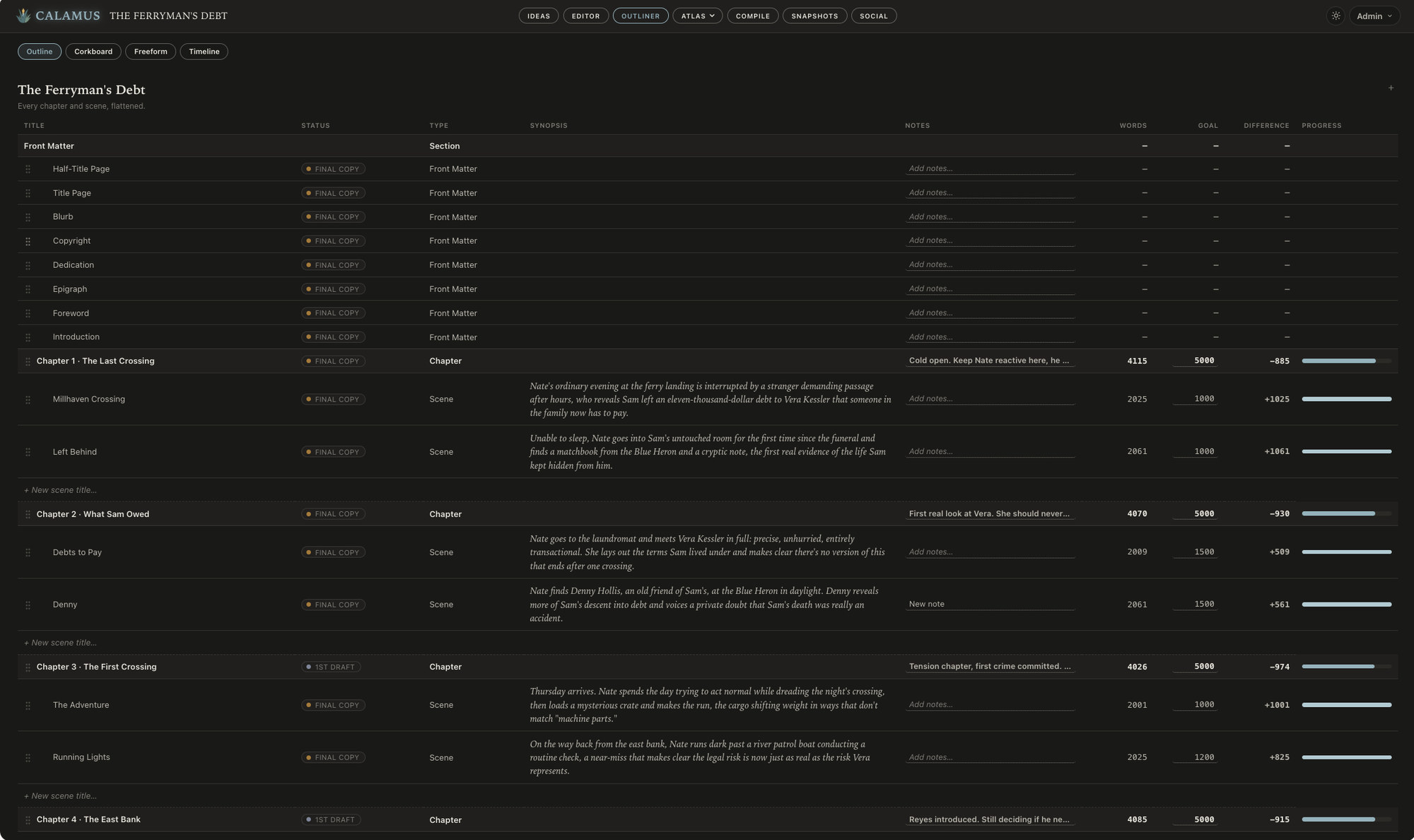
Record the count once, at the end of the session. Watching a number tick upward while you write pulls attention out of the sentence.
Set two lines rather than one: the target, and a floor. The target is 1,667. The floor is the number below which the day still counts, perhaps 500. Days with a floor are what carry a month through a week of unexpected obligations, because a 500-word day keeps the book open and the habit intact.
When the Word Count is Short
At some point in the month, most people are behind. It is close to being a universal experience in November because we're always mid-holiday season.
Work out the actual gap first. Behind by 4,000 words with 12 days to go means 2,000 a day instead of 1,667, which is 20 minutes more per session. That is a schedule problem with a schedule answer.
Then choose one of three responses, deliberately:
Raise the daily number. Works when the gap is modest and your writing time is flexible.
Add writing days or writing sessions. A single 4-hour session on a weekend can recover most of a week.
Move the finish line. Change the goal to 40,000 words, or extend to day 35. Nothing enforces the original figure except you, and a completed draft at a revised target is a completed draft.
If the sticking point is a scene rather than the schedule, skip it. Write a one-line placeholder for what happens in it, then start the next scene. Sequence is a revision problem, and you can write the hard scene in week 4 when you know what it needs to do.
Day 31
You have a complete first draft, and now you have two things to do with it.
First, get a copy of the draft as it stands somewhere outside the app, then leave it alone for two to three weeks. Snapshots are per scene rather than per book, so the whole-manuscript version of this is an export: compile a DOCX or an epub or a PDF, or ask for a full backup, and set that copy aside. Distance is the only reliable way to read your own prose as prose. Start something else, read other people's books, take notes on this one if they come, but do not open the file.
Second, when you come back, revise in the order that saves work: structure first, then scenes, then lines, then a proofread. Clear your [[FIX: markers early, since many of them are structural. Expect the first act to need the most work, because you wrote it before you knew what the book was.
Then the draft joins the ordinary process: revision, world reference tidied up from what you invented along the way, formatting, and a finished book. Calamus carries that whole arc in one place, from a note captured on a phone through drafting and world building to a print PDF at real trim size and sharing your book on social media, and it is $189 once with updates included. The 14-day trial runs the full app; during the trial Compile is locked and your files still download, and the pricing page has the details.
If you are still choosing the tool you will draft in, the guide to book writing software is the place to start, and it is worth settling before day one rather than during week two.
The month itself is worth doing on its own terms. In 30 days you can have a novel that did not exist before, which is a genuinely enjoyable thing to have done.
Chad & Melody
Co-founders of Calamus
The Calamus Team