The sticker price on writing software tells you very little on its own, because the apps are not sold the same way. Some charge once. Some charge monthly. Some charge once per platform. Some are cheap because they expect you to buy a second app to finish the book.
A five-year span is a reasonable window for a comparison, since it covers a few books for most working authors and it is long enough for a monthly charge to show real accumulated costs. Here is what seven tools come to over that period.
The five-year totals
- Dabble: $699 on the Author lifetime plan, or $1,140 at $19 per month on the Writer plan
- Codex Heim: $900, at $15 per month
- Vellum: $249, one-time
- Calamus: $189, one-time
- Atticus: $147, one-time
- Scrivener: about $122 for all platforms
- EmberWrite: $65, one-time
Paid monthly the spread runs from $65 to $1,140, and Dabble's lifetime plan sits inside it at $699. That is a factor of roughly 17 between the ends, a wide enough gap that it is worth looking at what your money is paying for rather than just picking the small number.
Subscriptions
A monthly charge is not automatically a worse deal, but it does add up over time.
Continuous updates while you are subscribed. Dabble and Codex Heim both ship updates to subscribers for as long as the subscription runs. There is no version 4 that you have to buy again. Whatever the app becomes over five years, you have it. The cautionary tale here is that with upgrades and updates, the monthly cost increases, too.
Hosting. Dabble runs in a browser and on mobile. Codex Heim runs in a browser. Someone is paying for the servers those apps live on, and in a subscription model that someone is you, monthly, in a predictable amount.
Sync as an included service. Both apps sync across devices without you configuring anything. That is infrastructure, and infrastructure has a running cost rather than a one-time cost.
If you value knowing that the software will keep changing and that your files are available anywhere without setup, a subscription is a coherent way to buy that. The number is larger because the service is ongoing. But just be aware that the cost can get out of control very quickly, as we've seen with Evernote and Canva.
One-Time Purchases
A one-time purchase buys one specific thing that a subscription does not: the software keeps working when you stop paying.
If you cancel Dabble or Codex Heim, access ends. Your words are exportable, but the app is no longer yours to open. If you buy Vellum, Calamus, Atticus, Scrivener or EmberWrite and stop engaging with the company entirely, the copy you have installed still opens your manuscript.
There is a second benefit. A one-time purchase has a known total. Five years from now, Calamus will have cost $189 and Atticus will have cost $147, regardless of what happens to either company's pricing. A monthly charge is a variable you have to deal with—by the time you decide to move on to a one-time purchase when the subscription model becomes too expensive, you will have already spent the equivalent on a one-time purchase model.
The trade is that a one-time purchase has no guarantee attached to future development in the way a subscription does. Scrivener is the clearest example: point updates are free, but major versions are paid, so the "one-time" price is really one-time per major version. Vellum, Atticus and Calamus all include future updates for existing modules.
Outside Costs
Three things regularly move the real total away from the number on the sales page.
Per-Platform Pricing
Scrivener is $59.99 per platform. If you write on a Mac and a Windows machine, that is two purchases. The five-year figure of about $122 in the list above is the all-platforms number, not the single-platform one, which is why it looks higher than the $59.99 you may have seen quoted.
The iOS app is a separate $23.99. So a writer who wants Scrivener on a Mac, a PC and an iPad is looking at three line items rather than one. Sync between them requires Dropbox or iCloud, which you configure yourself; it is not built into the app.
None of this makes Scrivener a poor buy. It has been the serious novelist's manuscript organizer for close to 20 years, and the Binder model it introduced has not aged although arguably the interface hasn't had any substantial modernized improvements. The Corkboard, the Outliner and the Snapshots are still a complete and coherent system, and plenty of writers have never needed anything else. It is worth knowing that the price is assembled from parts rather than quoted whole. We go through that in more detail on the Scrivener alternative page.
Hardware requirements
Vellum is $249 and runs on Mac only. If you do not own a Mac, the real cost of Vellum is $249 plus a Mac laptop or workstation, which changes the calculation entirely. There is no iPad or iPhone version.
Vellum produces genuinely beautiful print interiors with very few decisions to make, which is exactly what a lot of authors want from a formatting tool. You pick a style, you export, and it looks professional. That is a real skill in software design and it is why the app has the reputation it has. But it requires the author to import from writing and editing software. The Vellum alternative page covers where it fits and where it does not.
EmberWrite has a narrower version of the same issue: it runs on Mac and on Windows, but the Windows build is Apple Silicon only, which is an unusual constraint worth checking against your actual machine before you buy. Arguably, serious software developers create applications for all existing hardware. There are still millions upon millions of writers who have Intel chips.
Needing a Second App
This is the largest hidden cost, and the easiest to miss when comparing prices.
Some apps draft but do not finish. Dabble exports DOCX, PDF and Markdown, but does not produce a print PDF at trim size. Codex Heim exports a manuscript and nothing else. Scrivener's print PDF at trim size is limited. In each of those cases, if you are self-publishing a paperback, you need a second tool for the interior.
So the real cost of Dabble for a print author is $699 on the lifetime plan, or $1,140 paid monthly, plus a formatting app either way. The real cost of Scrivener may be about $122 plus Vellum at $249, or plus Atticus at $147. That combination is a perfectly reasonable way to work, and many authors do exactly that, but it should be priced as a combination.
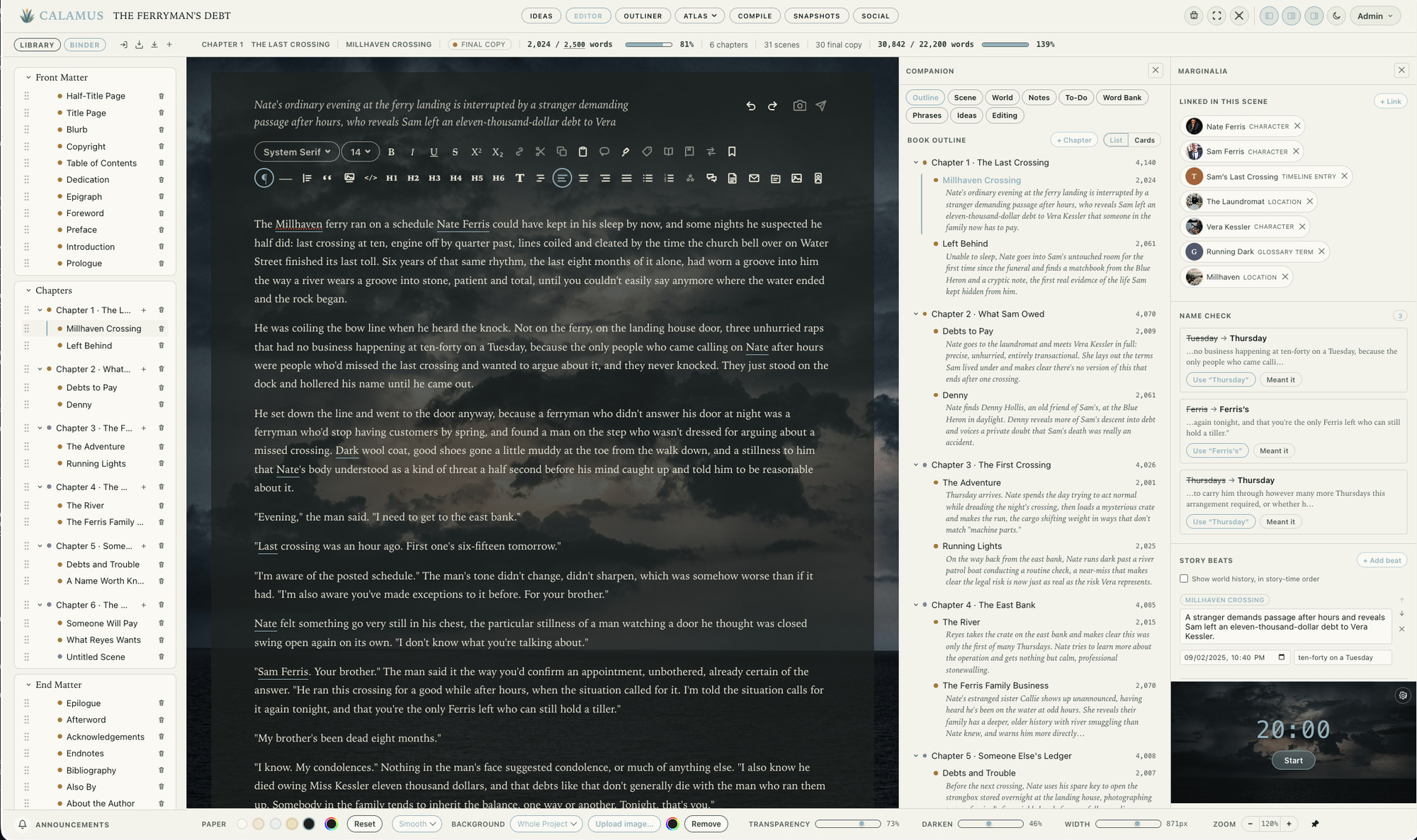
The apps that produce retail-ready EPUB and print PDF at real trim sizes on their own are Vellum, Atticus and Calamus. Calamus also carries the drafting and structure side, so the $189 covers the whole span from first note to finished files. That is the reasoning behind the number, and the pricing page shows the full comparison table this article draws from.
Reading the Table, Comparing Apps Honestly
A few closing observations, offered without a recommendation attached.
The cheapest option, EmberWrite at $65, does not sync and keeps local files on one machine. If you write on exactly one computer and back it up yourself, that constraint may cost you nothing. If you do not, it will cost you something eventually.
Codex Heim at $900 over five years limits you to 10 projects. For most authors that is not a live constraint. For someone with a long backlist it may be.
The one-time purchases cluster between $65 and $249, which is a narrow band. Within that band, what you are choosing between is scope, not really price. The subscriptions sit four to nine times higher over five years, and what that additional money buys is hosting and continuous development rather than more features on day one.
Pick the model that matches how you want to hold the software: rented and always current, or bought and always yours. Then compare within that model, where the numbers are close enough that features can decide it.
Once you have settled on a model, features decide the rest. The guide to book writing software is where those are laid out side by side.
Chad & Melody
Co-founders of Calamus
The Calamus Team